Auctor raises $20M led by Sequoia Capital

AI gave us the 10x engineer and the 10x marketer. It also created roles that had no name a few years ago, like the go-to-market engineer and the legal engineer. Services is next, and the people who will run it are starting to look different from the people who built the consulting industry.
For decades, enterprise software implementations have run through the same fragmented team:
Five people. Five handoffs. Five versions of the truth. The structure existed because expertise was fragmented, and projects needed every piece of it.
That premise is no longer true.
The technical-functional divide is collapsing. Purpose-built AI tooling makes platform configuration accessible to functional consultants, and business pattern recognition accessible to technical ones. The work that used to live in handoffs is increasingly something one person can do in hours (or less).
Discovery becomes scope. Scope becomes requirements. Requirements become design. Design becomes a working instance—all within a tight feedback loop with the client.
We've watched this happen across our customer base over the past year. The shape of a software implementation is changing, and so is the shape of the person who runs it.
Call them full stack consultants. This new persona can own work traditionally split across sellers, functional consultants, solution architects, project managers, and developers. Work that once required coordination across multiple specialists increasingly stays with one person. The people already exist. The industry just hadn’t settled on a name for them yet.
This evolution has happened before, twice in recent memory.
In 2017, Maxime Beauchemin published The Rise of the Data Engineer, naming a role that had emerged in the wild at Facebook and other technology companies through the early 2010s. The work had previously lived across business intelligence, data warehousing, and software engineering. Modern data infrastructure pulled it into one discipline. Today, "data engineer" is a standard line on every org chart, and the firms that recognized it first hired from an essentially untapped talent pool.
In 2023, Clay coined the term go-to-market engineer, a single role that absorbed work previously split across SDR ops, RevOps, and marketing automation. The title is now on req lists at companies like Ramp, Cursor, Notion, and Webflow. Earlier this year, Profound named the marketing engineer, a parallel compression on the brand and demand side. Both pieces did the same thing. They described a role that already existed in the wild and gave it a name hiring managers could write into a job description.
Services is next. The forces are the same: technology absorbs the work that used to live in handoffs, and the structural premise of the multi-role team stops holding. The pace is faster this time because the technology is more general. The same forces are now compressing the entire implementation lifecycle, from sales through go-live and beyond.
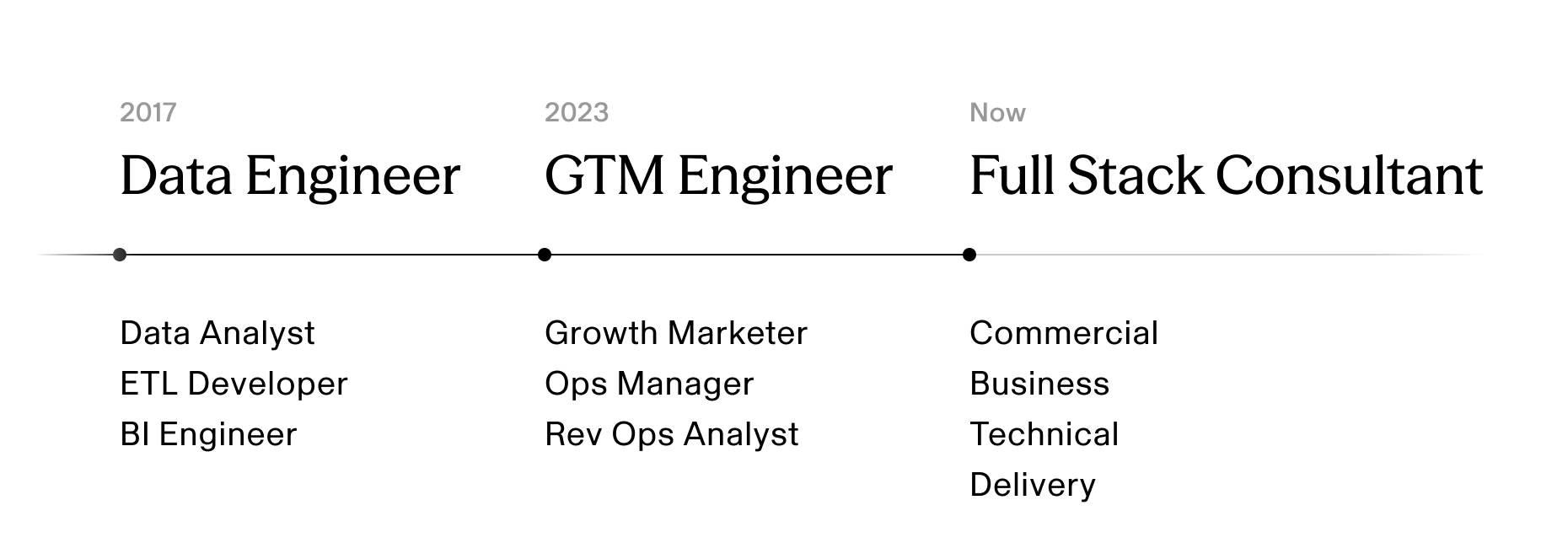
The full stack consultant is a different category of person.
At Black Diamond Advisory, Managing Director Vincent Valentine carries customer context from the first conversation through implementation. He takes part in discovery, shapes the solution, contributes directly to delivery, and supports the sales process that feeds it. That work would normally move between sellers, consultants, architects, project managers, and developers. Instead it stays with one person. The result is fewer handoffs, faster iteration, and a tighter connection between what customers ask for and what gets built. Valentine runs his work on Auctor.
"What I've delivered to my clients has fundamentally changed," Valentine told us. "I can't go back. I refuse to go back." The old categories of the role are falling away. Vincent is the full stack consultant.
At Ravus, a platform-neutral Q2C consulting firm, Principal Consultant and Solution Architect Ashley Bailey ran a complex enterprise CPQ and billing Salesforce implementation on Auctor with half the project team the firm would normally have staffed. The gain wasn't simply productivity. Customer context, requirements, design decisions, and delivery work stayed with fewer people throughout the engagement, reducing the coordination overhead that traditionally requires larger implementation teams.
The pattern is consistent. The boundaries between functional, technical, and delivery work dissolve when one person can do the work that used to require coordinating five.
Generalists are spread thin and shallow. The full stack consultant runs the opposite trade. Deep on the platform, deep on the customer's business, executing the full span because the tooling carries the parts that used to require additional people. Higher-skilled and higher-impact per hour worked, doing work that used to take a larger team to coordinate.
We initially expected the full stack consultant to be the most technical person on the team. The engineer who could code, who knew the platform deeply, who could absorb the functional context faster than the BA could absorb the technical context.
That's not what we've seen in our customer base. Deep technical skill doesn’t necessarily predict who takes to the new shape of work. Some of the consultants who've spent years working close to the bare metal, building their own tooling, and working through raw APIs, find it hard to fully trust a platform that handles in the background what they're used to doing by hand. They're not wrong to feel that way. They're adapted to a model the role is moving away from.
What sets them apart is how they think. They see how their own expertise, the context of the project, and the firm's tribal knowledge can be blended into AI tooling like Auctor to automate the mundane, highly variable work that consumes so much of the engagement. They stay the human in the loop, confirming or rejecting each part of the work and tracing any decision back to where the information came from.
The common factor is adjacent fluency and willingness to let the tooling carry the weight it's designed to carry. Technical depth on its own doesn't predict success here. The full stack consultant is the person who can absorb context across roles without resenting that the platform does the parts a craftsman used to.
This is the hiring signal that's underpriced right now. SI leaders looking for full stack consultants are searching for the most technical generalists they can find. The talent they should be looking for is the deeply contextual specialist who picks up everything else quickly because they're willing to work the way the new tooling lets them.
When we walk SI executives through this on calls, the question is consistent. What happens to everyone else?
The honest answer is that the same teams can take on more valuable work, while the company can take on more projects, changing the shape of their business. Across our customer base, the firms seeing the biggest gains aren't adding headcount. They're consolidating roles, so the team they already have can take on harder work and more of it. The added capacity comes from the consolidation, not from hiring.
The firms that treat this as a headcount story will reduce headcount and stop. They'll book the short-term margin and lose the long-term talent war. The firms that treat it as a capacity story will keep the same team size and double the engagement count, the deal sophistication, or the productized service lines they take to market.
The best part of this is what it means for the people on the team. The work that used to eat their week gets handled, and the hours come back. They spend that time on the parts of the job that drew them to it, solving harder client problems, shaping new offerings, owning a whole engagement instead of one slice of it. People grow into bigger roles rather than out of a job. A firm that invests its freed capacity this way builds something that performs better and keeps winning, even when the broader industry struggles.
The full stack consultant didn't exist five years ago. They will define services for the next decade.
However, the individual alone isn't enough. The full stack consultant can only do this work when the right people, processes, and tools come together.
The right people are the curious, contextual ones who take to the new way of working. The right processes give them a clean path from a customer conversation through to delivery. The right tools, like Auctor, carry the repetitive work and keep every decision traceable to where the information came from. Take away any one of the three and the role doesn't hold.
The firms that recognize this now hire for the new profile from a talent pool the rest of the industry hasn't started fishing in, and they put the processes and tooling in place that let those people work this way.
The firms that don't will keep posting for business analysts, solution architects, and project managers. They'll keep training people for roles that are consolidating. They'll keep staffing engagements the old way, against competitors who run them with leaner, more capable teams, and they'll feel it on both price and quality. The functional-technical pair won't disappear from job boards in 2026. But the firms that win the decade will increasingly expect individuals to operate across it.
The full stack consultant is already showing up at the firms that win the next 10 years. Every services leader reading this has the same decision in front of them. Hire or train for the role now and pull talent away from firms still posting against the old ladders. Or wait, and watch the best people inside the firm leave for the ones that did.
Auctor is the AI-native system of action for software implementations. Systems integrators and ISV professional services teams run the full lifecycle on a single platform, from pre-sales through go-live. Auctor is backed by Sequoia Capital and partners in ecosystems like ServiceNow, SAP, Oracle, Salesforce, AWS, HubSpot, Atlassian, and OneStream.